
Gen AI offers many benefits for learning. However, it also presents inherent risks for students. Like any digital tool, it must be used responsibly. Educators play a key role in teaching ethical and appropriate use.
What is Gen AI?
Gen AI, short for Generative AI, refers to artificial intelligence systems that can create new content based on user input or prompts. There are many types of AI generators including tools that can create original text, images, animations, 3D models, video, and audio. They are very simple to use and can produce professional results. In fact, they are now fully integrated into most Office and Internet applications.


Traditional Assignments Are Not AI Proof
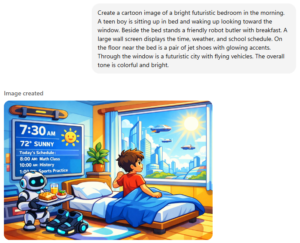
Gen AI is so powerful that it can complete many traditional school assignments. It can write a short poem in the style of Robert Frost in less than five seconds. In the blink of an eye, it can research a report about endangered species, cite reliable sources, and organize the facts using clear headings. It can even write a book report about a novel and add a fake personal connection to make the work appear student written. But AI tools do not stop at producing text.
Gen AI can also generate a wide range of outputs, allowing it to complete many tasks that teachers commonly assign. It can interpret data from a spreadsheet and turn it into graphs. Almost immediately, it can create downloadable slides on any topic to present using PowerPoint or Google Slides. It can even design an infographic.
When Student Work Becomes Effortless
In less than one minute, a student can complete an assignment. All they need to do is describe what they want, and AI instantly generates the result. If a student is unsure how to write a prompt, Gen AI can do that too! In short, AI tools can easily complete school assignments and research projects.
Students do not even need to type in the assignment description. Instead, with a single camera click, an AI tool can convert an image into text. It is easy to imagine how effortlessly homework can be outsourced to artificial intelligence.
Educators should not feel overly confident in their ability to identify AI generated work. Students can ask Gen AI to write at a specific grade level, include mistakes, avoid hyphens, or use short sentences. When students run the same work through multiple AI tools, detection becomes even more difficult. In addition, this technology is still in its early stages and improves every day.
The good news is that educators can use best practices to transform Gen AI into a tool that supports, not replaces learning.
What are the Pitfalls of Gen AI?
Educators are worried about Gen AI. When misused, it can weaken students comprehension, skillsets, and work habits. Below are six risks. Don’t worry, all of them can be avoided.
1. Promotes Shallow Learning
Shallow learning traditionally refers to tasks such as memorization, basic recall of facts, or mindlessly following steps that produce a surface level understanding of a concept or skill. Today with the rise of Gen AI, shallow learning can also occur when students use AI powered tools to quickly generate responses with little engagement in the content. This can create superficial understanding, poor knowledge retention, weakened competence, and limited long term growth.
2. Masks Skill Deficiency
Another risk of students’ use of Gen AI is masking skill deficiencies. A skill deficiency occurs when a student lacks the ability to perform a task proficiently. Since AI generated work often appears polished, it can effectively hide a student’s true capacity. As a result, learning gaps may go unnoticed. Over time, without an educational intervention, this can erode foundational skills such as decoding, writing, researching, mathematics, or problem solving.
3. Creates Overdependence on AI
Another pitfall of Gen AI is students becoming overly dependent on the technology. Students quickly notice that the work produced with AI assistance often appears better than what they can create on their own. This can reduce confidence in their own abilities. As a result, AI can easily become a crutch for for generating ideas, conducting research, interpreting data, writing text, and revising work. Overreliance on technology can create a cycle of self-doubt where fear of failure leads students to repeatedly turn to AI. Over time, this dependance can weaken critical thinking, creativity, and curiosity.
4. Encourages Academic Dishonesty
One of teachers main concerns is academic dishonesty. Cheating can occur when students submit AI generated work as their own. Since Gen AI tools are fast and easy to use, students may be tempted to avoid the struggle involved in learning new skills, building knowledge, and developing original solutions. It can feel rewarding to hand in high quality work with little effort. However, students may not realize that doing so violates school policies on AI use and could lead to serious consequences, including disciplinary action or expulsion.
5. Spreads Misinformation and Misunderstanding
Another concern related to Gen AI is the spread of misinformation. AI systems can produce incorrect or misleading information. However, students may lack the background knowledge or critical lens needed to identify these inaccuracies. Instead, they assume the output is accurate. This misplaced trust can shape understanding and beliefs in harmful ways. Once misinformation is learned, it can be difficult to unlearn.
6. Loss of Student Voice
A final pitfall of Gen AI is the loss of student voice. As students are still developing their personal style, reliance on AI generated writing with a generic tone can interfere with self expression. When artificial intelligence produces the text, students lose opportunities to communicate unique perspectives and opinions in their own words. Over time, this can marginalize diverse voices and limit original thought.
How Can Teachers Avoid the Risks of Gen AI?
Gen AI can enhance learning when used thoughtfully. Like any digital tool, students need guidance on appropriate and responsible use. Beyond teaching digital citizenship, it is essential to prioritize the learning process over the final product. The following tips can help educators design assignments that reduce academic dishonesty, strengthen critical and creative thinking skills, and build student confidence.
Materials and Resources
- Blend digital and analog resources (e.g., books, video, online facts)
- Require multiple tools to complete the task
- Use apps or platforms AI cannot access (e.g., Google Sites, Canva, Scratch)
- Provide an original template or structured outline
Instruction and Activities
- Design a task with multiple components
- Assign tasks with local or personal relevance
- Dedicate class time to monitor progress
- Share digital files to track revisions
Assessment and Evaluation
- Use ongoing multi-stage formative assessment
- Include diverse assessment types
- Require real-time demonstrations of learning
- Incorporate personal reflection
Critical and Creative Thinking using Gen AI
If you want to integrate Gen AI into learning, TechnoFuture AI prepares students with the skills they need for the future. In this project based course, students use generative AI to create original images, 3D models, music, and more. Along the way, they learn how artificial intelligence can be used responsibly to brainstorm ideas, produce personally meaningful content, and refine their work. Designed for middle and high school classrooms, TechnoFuture AI empowers students to unleash their creativity while developing ethical, thoughtful habits for using this powerful technology.