
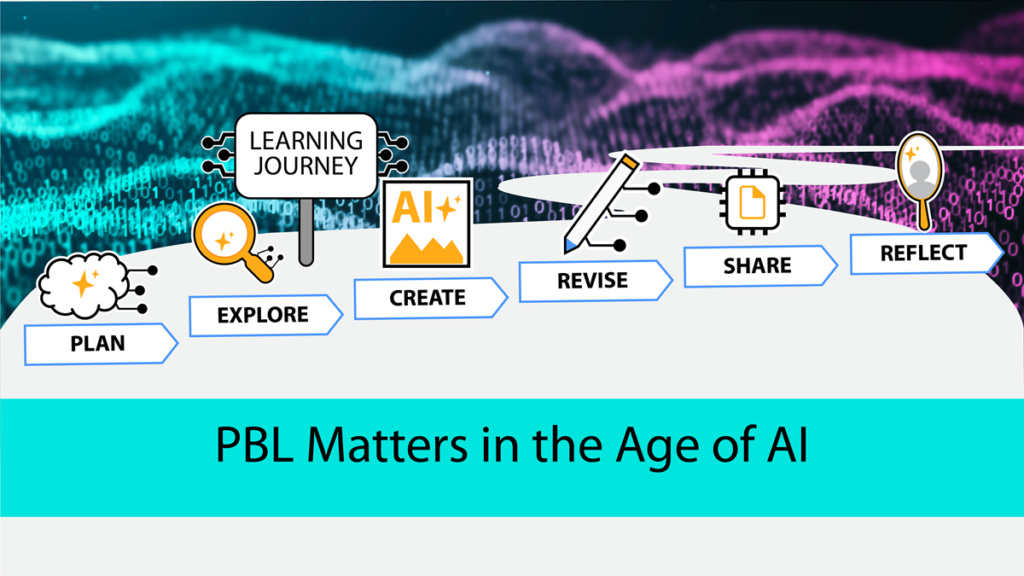
Project-based learning, or PBL for short, empowers teachers to address the challenges of artificial intelligence while thoughtfully integrating AI tools into learning. Teachers are worried that students’ use of AI tools could weaken learning. However, with PBL this concern fades away.
What is Project-Based Learning?
Project-based learning is an instructional approach where students gain knowledge and skills by actively exploring real-world problems, questions, and challenges that are personally meaningful. It engages students in meaningful tasks that require critical thinking and creativity. This approach provides students ownership to explore ideas, apply knowledge, and reflect on their learning. PBL moves beyond surface level tasks to sustained inquiry. It is an excellent way to build digital intelligence.
The PBL instructional approach has the following features:
- Real-World Connection – makes learning relevant
- Inquiry and Exploration – drives curiosity and deeper understanding
- Critical and Creative Thinking – develops problem solving and innovation skills
- Student Voice and Choice – increases ownership and personalizes learning
- Active Learning – encourages learning by doing
- Self-Reflection – helps students internalize learning
- Collaboration – develops communication and team-building skills
- Authentic Audience – gives projects meaning
- Cross-Disciplinary – connects subjects to the real-world
PBL Prioritizes the Process, Not the Product
Project-based learning occurs over time through multiple phases. Assessment is embedded throughout the project, with an emphasis on student growth. While there are six phases, they are not linear and do not follow a fixed sequence.

- Plan: Students are given a real-world problem. Based on the goal, they brainstorm and organize ideas often using tools such as a mind map or storyboard.
- Explore: Students build knowledge by researching facts, curating resources, investigating data, or exploring software application tools.
- Create: Students apply their knowledge to create a product related to a solution, often using digital tools.
- Revise: Students continually refine their ideas and enhance the product based on teacher feedback, self-assessment, or peer review.
- Share: Students collaborate with peers and share their work with others through a demonstration, presentation, game test, or other means.
- Reflect: Students critically examine the learning experience and consider their goals, strengths, weaknesses, and next steps.
PBL Matters in the Age of AI
Students are using Generative AI to instantly complete assigned school work. Generative AI refers to artificial intelligence systems that can create new content based on user input or prompts. There are many types of AI generators including tools that can create original text, images, animations, video, and audio. Here are just a few things that students are using AI tools to quickly do:
- research a topic
- summarize information
- create a report
- write a story or poem
- analyze, graph, and interpret data
- code a Python game
- produce a presentation
- generate an infographic
- compose a song
- translate a passage
Students can complete assignments with minimal effort by using AI tools. By prompting AI to write at a certain grade level or include deliberate errors, the work can appear authentic. This makes it challenging for teachers to know whether an assignment reflects student learning or AI generated content.
PBL Limits Academic Dishonesty
With how readily available and powerful AI tools are, teachers worry about cheating. Academic dishonesty can occur when a student presents AI generated work as their own. This tends to happen when the emphasis of a task is on the final product. The teacher evaluates the perfection of the work, and ignores planning, drafts, discussions, or reflections. Without PBL, the student can use an AI tool to earn an excellent mark without learning the material. Thus, this creates a disconnect between the final grade and student effort. But with PBL this does not happen because students must actively demonstrate their learning throughout the project. No more cheating!
| Without PBL | With PBL |
|---|---|
| Emphasis is on the final product making it easier to cheat. | The process of learning makes it harder to take shortcuts. |
| Assess the perfection of the submitted work, instead of growth over time. | Assess the plan, drafts, discussions, and reflections, as well as the product. |
| Work is submitted without learning the material. | Throughout a project, students actively demonstrate their learning. |
| There is a disconnect between final grade and students’ effort. | Students’ effort is clearly tied to their final grade. |
PBL Promotes Deep Learning
Teachers’ concerns are legitimate. Shallow learning can result from students using AI as a crutch. Instead of engaging in critical and creative thinking to solve a problem, learners can quickly use an AI tool. Now the work is perfect with minimal effort. When the focus is on the final product, students can avoid “hands-on” learning almost entirely. They do not have to persevere to develop an original idea or build understanding. Learning is short term. But with PBL’s emphasis on the learning process, there are no shortcuts! By blending knowledge and skills from different areas to construct learning students experience deep learning. This not only supports the transfer of skills to new situations, but it also promotes long term knowledge retention and skillset growth.
| Without PBL | With PBL |
|---|---|
| Students avoid critical thinking and problem solving. | Students engage in critical and creative thinking to solve problems. |
| Easy to copy instead of actively building skills or generating ideas. | Blend knowledge and skills from different areas to construct learning. |
| Learning is usually short-term and can undermine skillset growth. | Promotes long-term retention of learning and skillset growth. |
| Transfer of skills is weak, thus unable to apply learning to new tasks. | Deep learning supports the transfer of skills to new or real-world situations. |
PBL Celebrates Student Voice
Teachers that value self-expression, will want to use PBL as an instructional approach. This is because AI writing has a generic tone, and overdependence can prevent students from finding their personal style. When a task values the “right answer” or “perfect phrasing” over students’ unique ideas, viewpoints, and choices, then it is easy for learners to disengage from the learning experience. Most kids just want to get their work done as fast as possible. But, with PBL students have ownership over their learning, with tasks that are personally meaningful. They want to share their own ideas in their own words.
| Without PBL | With PBL |
|---|---|
| Tasks limit student choice and are teacher-driven. | Tasks are personally meaningful and emphasize students’ unique interests. |
| Students are encouraged to give the “right answer”. | Students are encouraged to share their ideas, viewpoints, and choices. |
| Weakens confidence and devalues self-expression. | Builds confidence in how they think and express their own ideas. |
| Students feel bored and disengage from the learning experience. | Students have ownership over their learning and are actively engaged. |
PBL Integrates AI Tools Effectively
But are AI tools bad for students? Not at all. Schools have a responsibility to prepare learners for the future, and that future includes AI. Since project based learning emphasizes the learning process rather than just the final product, it creates space for AI to be used in ways that enhance critical and creative thinking. When students use modern tools thoughtfully, they also build adaptability and confidence. To reduce dishonesty, educators should explicitly teach responsible AI use and intentionally integrate it into a project. For example:
- Plan: Students use an AI tool to jumpstart learning, by generating ideas, exploring a topic, or producing a task list.
- Explore: Students use an AI tool to simplify research to their reading level or seek clarity on something they find confusing.
- Create: Students generate original content such as images or music to enhance their work using original prompts.
- Revise: Students refine work using an AI tool and critically select changes from the generated suggestions.
- Share: Students share their work with the teacher at the start of a project so it is easy to monitor development over time.
- Reflect: Students critically examine their use of AI tools and justify choices.
I Don’t Have Time to Develop a Project-Based Unit
No problem! TechnoKids has over 40 digital literacy and coding courses that use a PBL instructional approach. Each one gradually builds students’ knowledge and skills. If you are not sure what you want, check out the TechnoKids Overview document, which summarizes each course.